
Scammers are constantly changing their tactics to make their schemes appear more legitimate. Recently, fraudsters have been targeting individuals by pretending to be law enforcement officers and convincing them to send money through Bitcoin ATMs, often called "Bitcoin kiosks."
How the scam works
A scammer contacts you claiming there is a warrant for your arrest, often for something like missing jury duty or another legal matter. They may tell you not to discuss the situation with family members, friends, or your bank or credit union due to supposed "confidentiality" requirements.
To make the scam seem real, they may impersonate local sheriff's deputies or government officials, including spoofing their phone numbers so that it appears the call is coming from them. You may be instructed to withdraw cash and deposit it into a so-called "Bail Kiosk" or "Federal Bond Kiosk" to resolve the issue. These machines are actually Bitcoin ATMs.
The scammer may claim the funds will be sent to a government agency or held as bond money. This is false. Once money is deposited into a Bitcoin ATM, it is typically sent directly to the scammer and can be extremely difficult to recover.
Warning signs to watch out for
Be cautious if:
- You receive an unexpected call claiming you owe money to law enforcement or a government agency.
- Official tax correspondence generally begins through mailed notices, not unexpected phone calls, text messages, emails, or social media messages.
- You are instructed to withdraw a large amount of cash for an unusual reason.
- You are asked to deposit cash into a Bitcoin ATM or kiosk.
- You feel pressured to act immediately or threatened with arrest.
- Someone stays on the phone with you while you're visiting a branch, ATM, or Bitcoin kiosk.
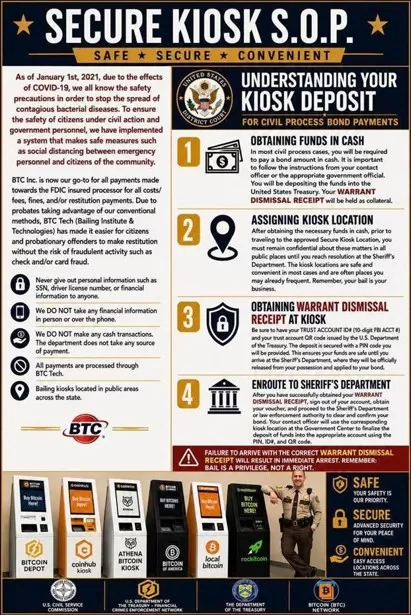
- The caller provides official-looking documents, badges, warrants, or images to make the request seem legitimate.
As a reminder, no legitimate government agency, law enforcement department, court, or sheriff's office will require payment through a Bitcoin ATM, gift card, wire transfer, or similar method to resolve a warrant, bond, fine, or legal matter.
Below is a recent example of a Bitcoin ATM scam:
How to protect yourself
Before withdrawing funds or making a payment:
- Take a moment to pause and verify the request.
- Contact the government agency or sheriff's office directly using a phone number from their official website.
- Speak with a trusted family member or friend about the situation.
- Ask questions if something doesn't seem right.
- Contact your credit union if you are unsure whether a request is legitimate.
If you think you may be a victim
If you believe you have shared personal information or sent money as part of a scam:
- Stop communicating with the scammer immediately.
- Contact MSGCU as soon as possible.
- Report the incident to local law enforcement.
- Monitor your accounts for suspicious activity.
MSGCU is here to help
Your financial well-being is important to us. If you are ever asked to withdraw cash, make an urgent payment, or send money through a Bitcoin ATM, contact MSGCU first. A quick conversation could help protect you from becoming a victim of fraud.
Stay alert, ask questions, and remember: if something feels suspicious, it's always okay to pause and verify before acting.
Category: Scam Alerts
« Return to "Scam Alerts"